

An invitation for families
To raise a child, you need a tribe.
The place where adults remember and children don't forget.
Santa Teresa · Nicoya Peninsula · Costa Rica
DEAR FAMILY
Letter from the
founders.

This letter is written with you in mind. It's about that conversation you might have at night, when the children are finally asleep and the house is quiet.
We had it many times. We are Sara and Juan, Carlita and Diego, two families who, each in our own way, arrived at the same question that kept us awake at night: what does it truly mean to accompany our children in their growth?
And we confess something: it hurt us. It hurt us to leave them six, eight hours a day in the hands of others, without knowing what they were experiencing, what they were feeling, what they were building while we worked. And it hurt us to suspect what we already knew: that the world has changed faster than any educational method can keep up with, and that what our children need is not another school. But rather another paradigm.
We wanted to return to something older and more genuine: a place where children and adults live together, where the home is once again the center, and where learning is not separate from living.
That's why Casa NUMA wasn't created as a school. It was created as a community: a shared home, with space for parents to work, moments of calm for each adult, and a protected time for each child's development.
We're not going to pretend we have it all figured out. We have something better: a purposeful quest, two families willing to support it wholeheartedly, and the certainty that this cannot be done alone. If any of this resonates with you, this space is also yours.
With love, and with all the responsibility that this path demands of us,
Sara and Juan, Carlita and Diego, and their daughters and sons.
It is not an education project.
It's a life project.
It's not an educational project. It's a life project.
Casa NUMA is a cultural and community association: families who decide, together, to create the conditions to support their children's growth, and their own, with greater presence, more community, and more meaning. And one phrase sums it all up: we bring families together. Each child's education begins within their family, and Casa NUMA provides what a family alone lacks: community, space, and culture.
And that "and one's own" is not just an embellishment. Something happens here that almost no one dares to name: while the child cultivates the genius that is still intact within them, the adult rediscovers their own, the one that life has gradually obscured. Both paths unfold in the same place and at the same time, in full view of one another. Because a child cannot sustain a calm, a coherence, or a joy that they do not see in the adults they love. Often, the first child we stop shaping is the one we once were.

At the same time, we take rigor very seriously. Our children are accompanied by guardians trained by the NUMA team, what other schools call guides, and who here look after something bigger than a classroom: the genius of each child.
Community warmth and pedagogical rigor are not opposites: they are two sides of the same coin.
At the same time, we take rigor very seriously. Our children are accompanied by guardians trained by the NUMA team, what other schools call guides, and who here look after something bigger than a classroom: the genius of each child.
Community warmth and pedagogical rigor are not opposites: they are two sides of the same coin.
A genius who isn't lost is forgotten
Genius is not about being better than anyone else.
It is being, without fear, exactly who you already are.
"No two raindrops are alike, nor are any two flowers identical. We don't want your child to be normal. We want them to remain natural."
In the late 1960s, researchers George Land and Beth Jarman administered a creativity test, originally designed for NASA, to 1,600 children. It wasn't that the children had something to spare—it was what adults, over the years, had been suppressed: layers of fear, comparison, and "that's not how it's done." Genius isn't lost. It's forgotten. And what is forgotten can be remembered.
98%
4 to 5 years old · "creative genius" level
30%
At age 10
12%
At 15 years old
2%
Among adults

What drives us
A few simple ideas.
Simple, but they change everything.


The environment teaches.
The environment teaches before any adult: we don't convince a child who to be; we create the ground where their genius grows on its own.


Attention is sacred.
In a world designed to steal it from her, teaching her to direct her own is the highest form of freedom.
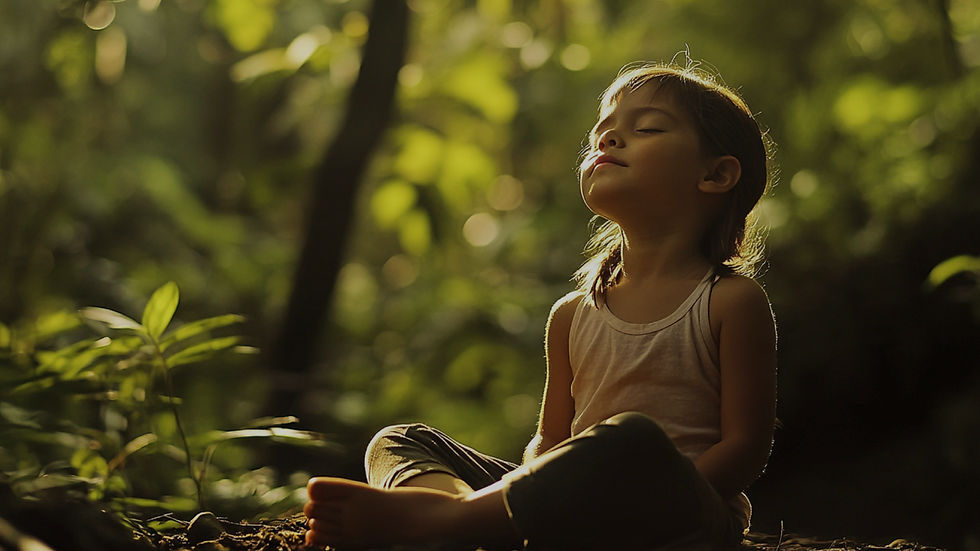

You don't learn: you remember.
We come to remove the noise, so that what already exists can reappear.


The mistake is a bonus.
Without permission to make mistakes there is no courage, and without courage there is no creation.


You enter by giving.
The question that opens the door is not "what am I here to get?", but "what do I have to give?".

We didn't come to invent fire. We came to gather the best embers that others lit, and blow them out.
01
Montessori
The environment is the true teacher: a child doesn't need to be pushed, but rather a prepared space and the confidence to do it alone.
02
Steiner
Learning breathes, and art doesn't decorate the classroom: it is the classroom.
03
Gardner
There is no such thing as an average child, because there are many ways to be intelligent.
04
Reggio Emilia
The best projects are born from a genuine question from the child.
05
Forest School
We learn within nature — and we take it to the end, because we don't have a relationship with nature: we are nature.
06
Neuroscience
The deepest learning happens in play and fair challenge, not in reward or punishment.

Pedagogical basis
Each child's tree.
THE ROOTS
The trunk
THE FRUITS


Emotions.
The virtues.
The harvest.
The difficult ones too: fear, anger, frustration; they are not hidden or punished; they are felt, accompanied and transformed.
They are practiced over and over again, through play, until they become a way of being: curiosity, courage, empathy, patience.
What the mature tree offers to the world.
And the tree keeps growing: as our children grow, the next stages will unfold, Flowers and Fruits, up to the age of eighteen. The group is a station: the tribe where the child belongs, plays, and is cared for. Progress is separate, based on mastery and one's own pace. Age dictates where you belong; mastery dictates how you advance.
01
Presence
A child who owns his own attention.

"Presence is consciousness made flesh."
So simple that an eight-year-old understands it, and so profound that it takes an adult a lifetime to truly grasp it. Each verb is practiced through play, becomes a skill, and matures like a fruit that the world receives.
Am
Awareness
I'm here
grows like
And it bears the fruit of
That is lived in
Me with myself
Three verbs. Three fruits.
One life only.
the compass
Coherence
grows like
And it bears the fruit of
Authenticity
A child who doesn't forget his genius.
Me with the other one
"Authenticity is consistency made manifest in life. "
02
That is lived in

I see
without deceiving myself
03
my answer
Sovereignty
And it bears the fruit of
Contribution
A child who creates, and who gives what he creates.
Me with the world
"The contribution is sovereignty made a gift. "
I choose
grows like
That is lived in
A path for every child
There is no such thing as an average child .
That's why every child has a personalized learning path, built upon their own individual talents, predispositions, and natural pace, rather than a one-size-fits-all approach. This path is developed by carefully observing each child in their daily life, listening to their caregivers, and engaging in close dialogue with each family.
As part of this approach, we also work with Human Design: a map of the unique way each child is made, how they make decisions, how they relate to others, how they replenish their energy. We use this map to fine-tune the environment to their nature, not the other way around. The map is not the territory: it is meant to be used lightly, never as a label or a destination, and the child is always greater than their map.
We believe the true task is to create the conditions for every child and every family to reach their full potential. That's why we also maintain strong ties with international leaders, so that our children can freely integrate into any educational system in the world at any time.
The map is not the territory; the child is always bigger than his chart.
We believe the true task is to create the conditions for every child and every family to reach their full potential. That's why we also maintain strong ties with international leaders, so that our children can freely integrate into any educational system in the world at any time.
The map is not the territory; the child is always bigger than his chart.
What we grow
Six dimensions, one house.

01
Comprehensive development
Body, emotion, mind and spirit as inseparable dimensions of growth.

02
Autonomy with roots
A free and self-confident child, capable of making decisions from within and not from external pressure.

03
Bond and community
The ability to live together, collaborate, and build healthy relationships within and outside the family.

04
Biophilia
The lived certainty that we are nature, and not something separate from it, with the earth, the sea and the cycles of life.

Personalized learning
A unique path for each child, respectful of their individuality, their pace, and their talents.
05

06
Families present
Parents involved in their children's daily lives, not spectators of their growth.

The stages of the tree
A path to, each child.
2 to 6 years
Seeds.
Symbolic play · harmonic rhythm · nature · emotional education
The seed takes root in life through free play, the body, nature, and authentic connections. We cultivate strong roots and a love for the world, supporting the child so they feel safe, loved, capable, and connected.


6 to 7 years
Outbreaks.
The seeds are sprouting: reading, writing, and research are taking on a more defined form, without losing the centrality of play and relationships. The missions are becoming more structured.
Literacy · logical-mathematical thinking · missions
8 to 12 years
Branches.
The branches reach out into the world: the child seeks to understand it, imagine possibilities, and express critical thinking. They want to collaborate, belong, and be valued for their authenticity.
Research · critical thinking · real-world missions · self-management

The rhythm of the day
Inhale and exhale.
Opening
Opening Circle
Songs, rhythmic games and shared intentions; a moment that opens up an internal space available for learning.
Inhale · first block
Invitation-only experiences
Personalized proposals according to each child's path and stage.
PAUSE
The shared table
Eating together is an educational act: it cultivates gratitude, autonomy, and care for food.
Inhale · second block
A second moment of concentration
With the same logic of invitation and personalization.
Exhale · free play
Free exploration
In the garden, the sea or the forest — the child chooses what to do and with whom.
Closing
Closing circle
We ended the day sharing emotions, lessons learned, and moments we experienced.
Every week.


A family workshop, where a family shares their trade with all the children: cooking, music, carpentry, gardening.
One day closer to the land and the sea, because nature is not an occasional stroll but part of the rhythm.
A community gathering where families come together to share, celebrate, and propose.

Learning: live and personal
From information to wisdom.
At Semillas, learning happens through the body, symbolic play, and sensory exploration. Language, pre-numeration, natural sciences, art and movement, emotional education, and connection with nature are naturally integrated.
At Brotes y Ramas, knowledge is organized around missions: real investigations, with their own questions, that integrate language, practical mathematics, science, history and geography, art, expression, and emotional and ecological education. Real challenges, with real consequences: cultivating a garden and bringing its harvest to the table, creating something and truly offering it, nurturing something living for an entire season. There, knowledge becomes practice, and practice, wisdom.
Rather than transmitting information, we aim for each child to ask questions, investigate, build hypotheses, make mistakes, correct them, and share their discoveries, thus developing the most important ability of all: learning to learn.
From genius to tribe
We go fast on our own.
Together we go far.
A child's genius is unique and unrepeatable, but it doesn't blossom on its own. It needs a nurturing environment: people who inspire it, who celebrate its risks, who give it space to be different. Almost no genius in history emerged in solitude: they emerged within a vibrant scene that supported them. Our grandmothers knew this, and they said it simply: it takes a village.
And there's something beautiful hidden in the word itself: "con-tribu-ir" (to contribute) has "tribe" at its root; "contribuir" (to contribute) was born, centuries ago, from "contributo a la tribu" (to give to the tribe). That's why a child growing up within a tribe doesn't learn to contribute in a single lesson: they learn it by living, because from day one they receive from many, and learn to give to many. We cultivate the seed, yes. But above all, we tend the soil, so that each seed germinates and learns to contribute. Because alone we go fast, and together we go far.
Who holds the way

The guardian.
A loving presence, not a dictating authority. She accompanies with sensitivity and respect for each child's pace, present, attentive, able to observe without over-intervening. She is trained by the NUMA team and supported on her own journey of reconciling with and remembering her own genius. Because an adult cannot instill in a child what they themselves have not remembered. That is why, here, the one who accompanies also flourishes.

The family.
Present, not a spectator. Each family participates, shares what they know, and sustains at home what is cultivated in the House.

The local community.
With its culture and territory, it enriches the fabric of all children, not just its own.
The greatest legacy
Our children are the greatest legacy we will leave to this world. More than any work, any fortune, or any name, what the future will truly inherit is the kind of human beings we raise today.
And if they are our greatest gift to the world, the greatest gift we can give them isn't things. It's the environment where they grow up:

The land
the quality of the gazes that sustain them
That's why we take such good care of the land. Because that land, one day, will be the world they inherit.

The tribe
that surrounds them

The house
that inhabit

We sow together
This project doesn't belong to us. It's a collective dream that ignites with everyone's active participation. And the door opens with a single question, the same one we asked ourselves when we started:
What do you have to give?
Write to us
For our children, for all of us, for a more humane, conscious, and luminous future.
NUMA House. Welcome home.
01
02
We talked
03